本網頁存在目的是為了推廣中央大學英美語文學系,藉由系上同學在林文淇老師所開設的「文學作品讀法」課程中所報告的簡報,讓其餘學生、高中生,可以更認識英文詩的奧妙與優美,進而體認到文學是可以細細品味,一輩子賞玩的。本小組所探討的主題為 “Society”
小組名單:
林鈺菁 981002009
高楚函 981002010
歐恩盈 981002506
本網頁存在目的是為了推廣中央大學英美語文學系,藉由系上同學在林文淇老師所開設的「文學作品讀法」課程中所報告的簡報,讓其餘學生、高中生,可以更認識英文詩的奧妙與優美,進而體認到文學是可以細細品味,一輩子賞玩的。本小組所探討的主題為 “Society”
小組名單:
林鈺菁 981002009
高楚函 981002010
歐恩盈 981002506
981002511 梁瑜芮
淺談 “Richard Cory"
一、作者簡介
Edwin Arlington Robinson:他1869年出生於美國緬因州(Maine)Head Tide這個城鎮,成長於Gardiner這個新英格蘭小鎮,在這個小鎮的生活給了他很大的啟發,對於他的創作有著很大的影響,更成為他詩中的重要題材。在1891~1893年,他進入了哈佛大學就讀,並且在Harvard Advocate上,發表了他的第一首詩,在1896更以自己的資金發表了第一本完整的詩集 “The Torrent and the Night Before" ,隔年發表 “The Children of the Night” 。1903~1904年,這兩年可能是此作者較失意的兩年,因為沒有任何專業領域上的成就又苦無機會發表新作品而酗酒,後來遇上了Edmund Clarence Stedman,他不斷的激勵作者,並介紹其他詩人給作者認識,作者也在此時期修復和之前的哈佛同袍William Vaughn Moody的友誼。終於在1905年,作者的詩作獲得當時總統Theodore Roosevelt 的賞識,總統也為他在New York City Custom House安排了一份工作。在1910年,出版了兩本詩集:The Town Down the River & The Man Against the Sky,這更讓Edwin的名聲更加響亮。在接下來的幾年都有作品持續發表,更在在這三年1921、1924、1927得到了詩人一生中的最高榮譽---普立茲獎。逝世於1935年4月6日。
二、Richard Cory
981002010 高楚函
Emily Dickinson的這兩首詩都是在敘述有關於名聲、名譽,並用一定的程度的比喻來讓詩中所要強調的主題更活靈活現。此次報告主題為”Society”,而社會上的某個議題也是越來越嚴重,那就是人們汲汲營營的追求名利。
“I’m Nobody! Who Are You!”
I’m nobody! Who are you?
Are you nobody, too?
981002509潘怡安
以下是W. H. Auden 的詩:The Unknown Citizen,有附上翻譯,後面還有進一步關於此詩的解釋以及我的心得感想。
He was found by the Bureau of Statistics to be
依照統計局他乃是
One against whom there was no official complaint,
981002506 歐恩盈
The Unknown Citizen – A Harsh Accusation or a Simple Depiction?
Imagine, how is
it like being an unknown citizen? What is your definition of an unknown
citizen? How would you like it if you are the only one alone as an unknown
981002009 林鈺菁
以下的詩是由E.E. Cummings所寫的 Next to of Course God America I.
而E.E. Cummings 的作品大致可分為兩類:抒情詩以及諷刺詩,而本詩便是諷刺詩的其中一個例子。
The Woman Warrior is very different from ordinary novels. I get a sense of achievement after finishing the book. However, honestly speaking, I don’t understand some of the plots in the book, such as White Tigers, the ape-man in Shaman and legends about China. Sometimes I can’t tell whether the description is real or unreal. I can’t follow the author all the time because the plot changes so quickly. Also, I am confused by the names which are hard to look up in the dictionary. They bother me while I am reading the novel. Although I encounter these obstacles, I still enjoy reading it. It reminds me some of the legends about China, though they are not always correct. According to Lili, that’s because Maxine Hong Kingston is Chinese-American. Via her novel, I understand taboos among Chinese women, the Communists, old villages in China, how the villagers live and how they gossip each other. She tries to show us the difference between Chinese culture and American culture. What’s more, immigrants are the leading roles in the novel. I realize the hardship of being an immigrant in America. They suffer from racism, sexism and capitalism. They have to work so hard that they can only have adequate clothing and food. Besides, they are striving to earn money in order to send money home. By doing so, their family can fly to America and settle down, having their reunion. The girl in A Song for a Barbarian Reed Pipe forces a little girl to talk because she thinks the ability to talk is important. If she can’t talk, she will be bullied by those “ghosts.” The way she describes people as ghosts is s a special technique, creative and mysterious. In addition, I like the last paragraph on page206: “Here is a story my mother told me, not when I was young, but recently, when I told her I also talk story. The beginning is hers, the ending, mine.” It seems that she has learned how to talk story from her mother. In sum, it’s an interesting book. I’m glad I have finished reading it.
I went to Taipei and paid my high school classmate, Yuting, a visit on May 7. Actually, it was she that asked me for help: to be her model for her homework. She is a student of Shih Chien University, majors in clothes-designing. When I arrived at Taipei, she came to pick me up at the train station. Then, we went to her friend’s house by taxi. Two of her classmates helped me dress up (hair style and makeup). After dressing me up, we headed for Shih Chien University to take pictures. There were three style of clothing designed by Yuting. They are special because they were made of paper! How amazing! We started photographing after I put on the “clothes.” At first, I was very uneasy and didn’t know what to do. Fortunately, Yuting and her classmates helped me out by instructing me how to pose in a nice-looking way. In the process, I enjoyed being a model. I like the clothes and the experience of being under the spotlight. It’s fun to be a model. However, I know being a model is not that easy. Models are always losing weight and on a diet. They can’t enjoy delicacies to their content as normal people. They are afraid to see the number showed on the scale going up. Even so, if Yuting asks me for help again, I will say yes. I’m glad to help her. It’s an honor to be her model.
After finishing the work, we went to 士林night market. We shopped and ate a lot of food. I liked shopping in the night market because there were great bargains. All of us bought something special. In sum, it was fun to hang out with Yuting and her friends. I really had a good time. I hope I can pay her a visit soon.
Voyage 15840 is a photo book compiled by TIWA(Taiwan International Workers’ Association). Migrant workers,which can be viewed as immigrants, speak out their feelings via daily photographs and simple words. Through simple images and words, they try their best to reveal their interior thoughts to us. The book thus provides a chance for us to understand them more. I choose one of the stories from the book as my post.
The story written on page 48 draws my attention because of its unfamiliar look. The photograph was taken by Alice E. Dimzon, who is a factory worker. At first, you may think it is just a normal lunch box and there is nothing special about it. Later, as you take a closer look, it is easy to see that the drumsticks are much smaller and than usual. Significantly, the most meaty and delectable part is missing, I suspect that this has to do with discrimination and disrespect. You would not expect to see this normally in the restaurants in Taiwan. As to the lunch box itself, it looks boring because of its dull color. As a whole, it seems unpalatable. I would not have something like this personally.
Yearnings and sadness are the fleeting feelings captured in the words because Alice mentions that every time she opens the box served in her factory, she already loses her appetite. Yet, she still forces herself to eat it even though she dislikes the taste so much. If she doesn’t do so, she will starve and have no strength to do the heavy work in the factory. Thanks to the sauce from the Philippines, she can rely on it when she doesn’t like the taste of the food. With it, she doesn’t need to worry about the taste anymore. We enjoy Korean delicacies with special sauce to enhance the flavor but that’s totally different from her situation.
As a citizen in Taiwan, as it should be, I don’t have problem adapting myself to Taiwanese food. However, I may get a chance to study abroad in the future. To stand in their shoes, I can easily experience migrant workers’ alienated situation. What’s more, migrant workers see what I don’t see. If I didn’t read Voyage 15840, I would never get the chance to take a look at the meal served in the factory, not to mention the challenge they face. Before I read the story and saw the image, my impression about migrant workers was that they worked in factories or took care of the old. I never thought about the difficulty they confronted in daily life. Although there are exotic restaurants, the taste may not be as authentic as it is in their homeland. Here is a crueler question: “Do they have enough money to afford the exquisite meal after being exploited so many times?” The answer is probably “No.”
Alice E.’s story makes me understand migrant workers better than before. It gives me a lot of new aspects and points of view. Also, I can comprehend their ways of thinking and of experiencing culture shock. As an immigrant, I believe she has many stories to tell. Maybe the story I choose is only the tip of the iceberg. However, it has already broaden my horizons.
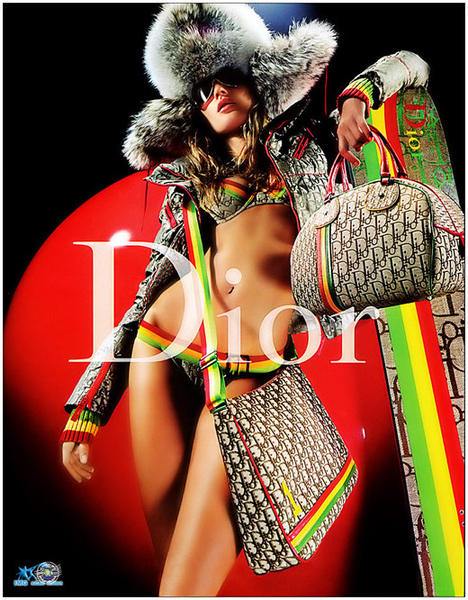
It is vital to tell the difference between publicity and the pleasure which the product it advertises brings. Publicity is successful accurately because it feeds upon realities. It starts with undertaking a natural appetite for pleasure. However, it cannot provide the real things of pleasure. Also, there is no persuasive object for a pleasure in that pleasure’s own terms substituted for it. Publicity is never a praise of a pleasure-in-itself but always about the future buyer. It is about social relations, not the product itself. It brings the happiness of being envied, which is a solitary form of security. Sharing your experience with those who envy you will make you less enviable. The absent, unfocused look of the models in glamour images shows that they are sustained by the looks of envy.
The model in the ad is wearing a colorful bikini, a jacket and a pair of sunglasses. She is leaning on a surf board with a bag on her hand. There is another one beside her waist. All her stuff is printed on the logo of the brand name. The eyes behind the sunglasses might be half-opened, showing her conceit. Her slight-opened mouth shows her sense of superiority and enjoyment. She looks as proud as a peacock and has a lot of confidence in herself. She enjoys the look of those who envy her as if she is a super star with thousands of fans. They cannot possess what she has—the luxuries. Her nice figure, clothes, bags…everything on her can be envied. It is the happiness of being envied that makes her shine like a star.
“You should never spend so much money on whatever you want. Earning money is not an easy task,” my mom said angrily. I was as silent as a winter cicada, listening to my mom’s lecture. After a while, she finally calmed down and murmured, “Please stop shopping for unnecessary things such as clothes and shoes. You have had lots of them already. You have food and clothing sufficient for your needs, much more sufficient than I did when being at your age. ” Then, she began to recall those hard days.
“When I was little, the financial condition of my family was poor. Your grandma used to do the laundry for rich families. She worked hard and seldom took a good rest in order to make ends meet. She had to raise three daughters by herself because your grandpa died in his early life. She had no choice but to earn a living painstakingly. This made her a thrifty mother,” my mom spoke in a tender tone. “She always reminded us the importance of being frugal. If she found that we spent money on candies and toys, she would be displeased. Sometimes she even punished us. I can not stand in her shoes until I start my work career and have a family. Money won’t come into your account unless you work for it. When you were an infant, the expenses were huge. Milk powder, diapers, health examinations all cost money. I had three part-times jobs: working in a beauty shop, a wedding studio and an insurance company. Only to do so could I strike a balance between incomes and expenses. Once in a while, your dad and I had to eat instant noodles to save money. We really had a hard time. That’s why I got so angry when knowing your extravagant behavior. I just want you to know that making money is not easy.” After hearing the talktale, I was ashamed of my lavishness and admitted my fault. Since then, I stopped wasting money.
Recently, I started tutoring in English because I want to reduce the given living expenses. I don’t want to burden my parents with extra expenses. In addition, I realize the hardship of gaining money and the value of saving money. Even though earning money is not that easy, I’m glad I eventually grow up and know how to manage my money. I hope my parents will be proud of me. (I haven’t told them the news.)
My father has two brothers, so-called, my uncles. The most junior one is the no name man in my family. He is a forty-year-old bachelor, who works for a building company in Taipei. We seldom saw him because he only comes back to Hualien when Chinese New Year is coming.
He is tall, fit and swarthy because he is often exposed to the sun during his long-hour, laborious working days. His dark skin makes his exotic facial feature looks more alike foreigners from Southeast countries. In addition, he is a deaf-mute. That means he can’t speak and listen. Therefore, he is easily neglected because he can hardly join our conversations and interactions. While we are watching TV programs, he can only read the subtitles. While we are appreciating live performances on TV, he can only enjoy the soundless dancing. While we are talking happily and excitingly to each other during Chinese New Year, he can only guess what we are doing by observing our facial expressions and gestures. While we are chatting on the phone, he can only type text messages instead. The only way we can get along with him is by using body language and written words. We exchange messages by using eye contact, gestures, facial expressions and writing down what we want to say. However, I wonder whether he receive the definite messages.
Now, he is at his forties, still being single. Sometimes, I feel sorry for him, for he has been so lonely these years. He never gets the chance to experience what is love except the love from the family. Maybe he never thinks about it. He has lived with my grandfather in Taipei on account of work for over ten years. However, my grandfather will pass away some day. He can not take care of my uncle forever. If he didn’t get a spouse, he might feel more lonesome. I hope he can find his true love one day, a kindhearted woman who can have a family with him and always keeps him on her mind. Let him never be forgotten, forever and ever.
